

The queues aren't for Rolex. They're for gold.
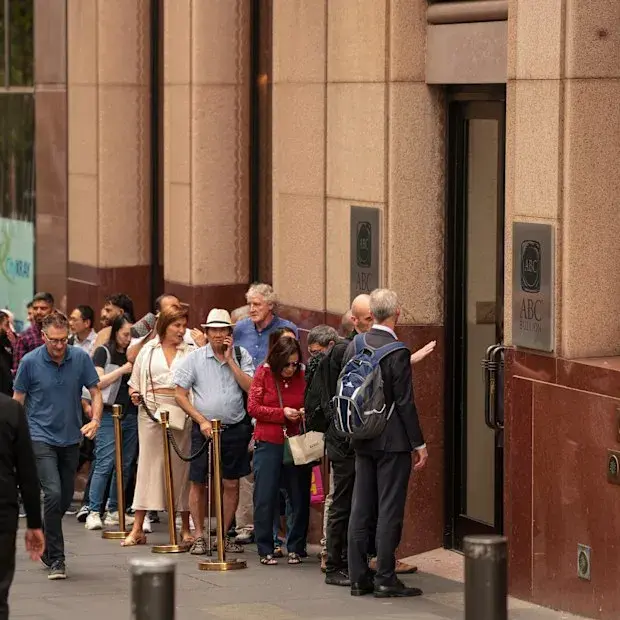
If you’ve walked through the CBD in the past fortnight, the snaking lines outside Martin Place aren’t luxury-watch diehards. They’re retail punters and family offices queuing at ABC Bullion to swap cash for metal. Sydney police even asked the store to move crowds along as spot prices ripped to fresh records.
What just happened: a parabolic week on top of a monster year
Gold briefly topped about US$4,300 per ounce last week, cementing one of its strongest weekly surges since the global financial crisis and taking year-to-date gains to roughly 60 percent. Futures eased into Friday’s close, but the move was still the biggest weekly advance since December 2008 by Reuters’ count.1
Zoom out and the impulse looks broader than a one-week squeeze. Prices have repeatedly set new all-time highs through 2025, driven by overlapping risk clusters: renewed US–China trade tensions and tariff salvos, wars in Gaza and Ukraine, a wobbling US banking sector, and a sharply weaker US dollar. Each of those factors independently pushes investors towards assets without counterparty risk; together they created a classic safe-haven bid.2
Why now: the 2025 cocktail
Rates and the dollar. Expectations of further US rate cuts lower real yields, mechanically improving gold’s relative appeal. The dollar has also had a bruising year, with first-half declines noted by major asset managers, amplifying foreign-currency bids for bullion. 
Central banks. Official-sector buying has underwritten the rally. China’s central bank extended its spree to an 11-month streak into October3, while global central bank demand remained a key pillar across the first half of 2025 after 2024’s record.4 Survey evidence shows reserve managers still leaning pro-gold over the next five years.5
Retail and ETF flows. Western ETF holdings have flipped from outflows to inflows, and the queues for physical coins and bars in Sydney are the local expression of the same impulse: investors hedging policy and geopolitical risk with something tangible.
What gold is (and isn’t) doing in your portfolio
Across long horizons, gold has behaved as a strategic diversifier with low correlation to risk assets and a tendency to outperform in episodes of stress. That’s not marketing copy; it is well-documented in central-bank and market-structure research. It’s also not a one-way ticket: the metal is volatile around inflection points and can lag when real yields rise or risk premia compress.6
What the Street now thinks
Price targets have been marching higher.
Goldman Sachs lifted its end-2026 target from US$4,300 to US$4,900, explicitly citing renewed ETF inflows and persistent central-bank buying.
HSBC now projects US$5,000 in the first half of 2026 on similar drivers.
JPMorgan’s published base path sees > US$4,000 by mid-2026, with separate client work outlining scenarios that could carry to US$6,000 by 2029 if even small portfolio reallocations occur.
Why the queues: from gold bezels to gold hedges
When uncertainty is high and information is patchy, mum-and-dad investors reach for simple hedges they understand. In 2025 that has meant physical gold, coins and small bars, as a store of value that isn’t anyone else’s liability. The run-up in price hasn’t deterred that behaviour in Australia; it has arguably validated it.
Gold’s role in episodes of policy shock and war is consistent: it tends to hold purchasing power when confidence in currencies wobbles. The European Central Bank’s recent stability work shows gold outperforming typical safe assets in acute risk spikes, even as it lags during benign expansions. It is a hedge, not a growth asset, and it works best when everything else doesn’t.8
Looking ahead
After the blow-off, gold whipsawed. Spot fell roughly 6 percent mid-week to around US$4,107 as overbought conditions met profit-taking, before stabilising.9 That’s a feature, not a bug, of parabolic phases. ING Analysts credit overzealous buying alongside cooling US-China tensions as the cause, as investors began to question the long-term growth potential. This profit taking maneuver served largely as a tactical exit, as the long positions on the precious resources were being looked at through an
increasingly anxious eye.10

Disclaimer
We’re a student society, not licensed advisors. Please treat this as general information for your brain, not instructions for your wallet. We don’t know your objectives, financial situation or needs. Before you buy, sell or bury any gold in the backyard, talk to a qualified professional who actually holds an AFSL. Read the relevant PDS, sleep on it, and remember that past performance is like your mate’s hottest take: entertaining, not predictive. This is not financial product advice under Australian law. 
For the dry version, see ASIC’s guidance on general versus personal advice and the Corporations Act definition of “financial product advice”.
Comments